Tackling the “Multi-Generational” Challenge
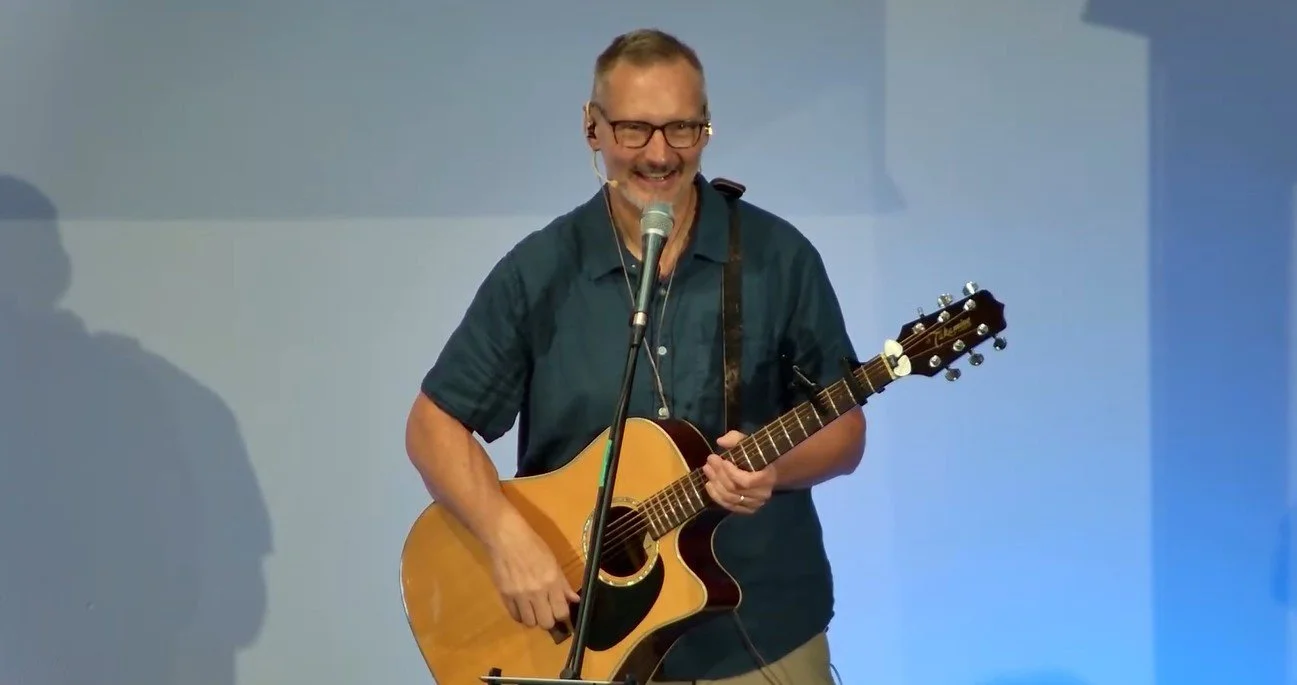
The sanctuary lights dim, and a quiet buzz of conversation fills the room. Whispered greetings mix with the sound of my guitar, bringing warmth to the pews. For nearly 30 years, I’ve stood on church platforms with my acoustic guitar, looking out at many faces. I’ve seen musical trends come and go, and I’ve helped churches move from hymnals to transparencies, and from overhead projectors to LED screens. Still, one challenge always remains: How do we help a 16-year-old and a 94-year-old worship together so neither feels out of place? We face that challenge here at Walnut Creek Mennonite Church, and I know many of you do too.
The metaphor we often use to describe this is a large-group bike ride. We have all varieties of ability, ages, fitness levels, and preferences on where we go, how fast we ride, etc. Should we set a pace that the young, fit, passionate riders want to set? Dropping people off the back to fend for themselves all the way home? Or do we all drag along in a slow pack, allowing our newest and least experienced riders lead? Forcing togetherness is fine, but it can frustrate those who want a challenge.
In this post, I want to share practical strategies that have helped me bring together different generations in worship. We’ll talk about choosing songs, arranging instruments, balancing lyrics, and connecting different styles. Here are the main areas we’ll look at:
1. Using accessible instrumentation to build bridges instead of barriers
2. Balancing theological depth and emotional connection in our song selection
3. Crafting effective transitions and “pastoral bridges” between styles
4. Addressing technical factors like keys and volume so everyone can participate
5. Fostering a multi-generational team culture on the platform
You can use these examples as practical steps with your worship team.
Leading musical worship today is more than just mixing old and new songs. It’s about something deeper. Picture a grandchild holding their grandparent’s hand as they worship together, singing songs from different times with the same sincerity. That’s what it means to be God’s family: all ages worshipping together as people who belong to each other. If we focus on just one group, we stop being a family and become a club. As leaders, our job is to create spaces that invite everyone into God’s presence.
1. The Acoustic Guitar as the Great Leveler
I may be biased, but I think the acoustic guitar is one of the best ways to bring generations together. Its sound is warm and honest, inviting people of all ages to join in. For older listeners, it brings comfort and a folksy warmth. For younger people, it adds energy and rhythm. Whether the guitar sounds mellow or bright, it helps everyone feel welcome and connected. While I play the acoustic guitar, other instruments like the piano can also create these connections when used well. Our article today will focus primarily on the guitar, but teams can use these ideas with whatever instruments they have.
For older people, the acoustic guitar feels familiar and approachable. For younger people, it’s the foundation of contemporary music. To help these generations meet in the middle, I use two specific techniques:
The “Rhythmic” Hymn: When I play a traditional hymn like Holy, Holy, Holy, I don’t just use the usual strumming patterns. I often use Drop D tuning (drop that E string to a D) to give it a modern, deep sound. Playing the low D string adds a “resonate” depth that older listeners enjoy, while the steady rhythm keeps younger listeners interested. We usually start these hymns in a classic style, with harmonies from the hymnal. By the second verse, we add more instruments and energy with drums and bass. Here’s an example from a recent service at Walnut Creek Mennonite: How Marvelous
The “Contemporary” Strip-Down: When we choose a higher-production song by artists like Chris Tomlin or Phil Wickham, we often strip out the heavy synths and electric guitar parts. Instead, we use just an acoustic guitar, electric piano, bass, and drums to give the song a more acoustic feel. Usually, one person sings the lead melody, and others add harmonies. This helps the “new” song feel familiar and safe for someone who grew up on the Gaithers. Here’s an example from a recent service at WCMC: What He’s Done
2. Theological Depth vs. Immediate Connection
A common challenge is the theological “density” of the song lyrics. Traditional hymns are usually “vertical,” full of deep theology and serving as an anchor for foundational aspects of our faith. Songs like "Holy, Holy, Holy" and "Great Is Thy Faithfulness" focus on God’s character and works, directing our attention to Him alone.
Contemporary songs are often more “horizontal” or personal, focusing on our response to God and building a sense of community. Songs like "Goodness of God" and "How He Loves" share our feelings and prayers directly with God and invite everyone into a personal experience. In short, vertical songs are about God, while horizontal songs are sung to God, sharing our feelings and prayers.
We need to remember the past and honor the history of our faith. Traditional hymns do this because they have lasted over time. They remind us that our faith has a history, and Jesus is obviously timeless. They also give us words for suffering and God’s sovereignty that modern songs sometimes miss.
However, without relevant contemporary praise, our worship can become “intellectually cold.” Modern songs give us a language for our current moment. They allow the younger generation to express their passion in a way that feels authentic to their own cultural time and space.
A helpful metaphor I’ve discovered is jumping on a trampoline. Theological depth (pressing down on the trampoline) can and does balance the exciting, relevant contemporary melody (the flight of the jump). We believe that the deeper we press down, the higher we can fly up!
3. Using speaking and praying as a “pastoral” bridge during worship.
When we plan our worship sets, we look for a theme that connects the songs to the day's overall goal. If the sermon is about God’s faithfulness, we might start with a modern song like Goodness of God and then move to Great Is Thy Faithfulness.
We love to see someone touched by the new song, then singing even louder for the older one, realizing both songs tell their story. These moments show how a common theme can bring people from different generations together.
We typically speak less during our worship sets. However, a timely ‘pastoral comment’ can bridge between two songs. This is the moment to not just explain the "Why," but to draw your congregation into the story. Before launching into an explanation, try inviting everyone to reflect together: "What promise of God anchors you today?" or "When was the last time you sensed God's faithfulness in your life?" Asking a question turns the moment into shared reflection, opening hearts for the song to come. Then, as you introduce the song's origin, you are building on the ground your listeners have already made personal.
Here is a great example from my friend and coworker, Sarah Hochstetler, during a recent service at WCMC:
The goal is to give people an easy invitation to join in, even if they don’t naturally connect with a certain style. It’s normal for some team members or congregation members to feel hesitant or unsure when new styles or songs are introduced. In these moments, open conversation is valuable. Invite honest discussion about what feels unfamiliar and why. When we meet resistance with empathy and a willingness to listen, trust grows, and hearts open over time.
To the younger generations: “We’re singing this historic hymn because these words have sustained Christians through centuries. Let’s lean into that strength.”
To the Seniors: “We’re singing this new song because it’s very relevant for today. It is a ‘new song’ the Bible commands us to sing. Let’s join together in this fresh expression.”
4. Technical Considerations: Keys and Volume
After 30 years, I’ve learned that people want to hear themselves and those around them when they worship. Individual worship often stops when people can’t hear their own voices- especially if the instrument and band volume is too high.
On the contrary, many have told me they’re also hesitant to sing out if they’re the only voice they hear. If they feel exposed to sing out,they are hesitant. We can address this with technical and practical solutions, helping the congregation succeed rather than struggle. The truth is, more and more people in our congregations aren’t trained singers, can’t read music, and don’t know music theory.
The “Key” Factor: Many contemporary songs (and some hymns, too!) are written for professional vocalists with huge vocal ranges. If you lead a song in a key that’s too high, the older generation (and most men) will simply stop singing. I am a firm believer in the “Step Down” method. If a song is written or performed in B, but the melody stays in the higher range for too long, I’ll drop it to A or even G. With a guitar, this is quite simple and may serve everyone very well.
Dropping the key allows most voices in the room to participate comfortably. Use your capo to find the key where the congregation sounds best, not where the recording sounds best. (I know, I know, — but remember your FIRST responsibility as a worship leader!)
For pianists and teams that do not use guitar, the same principle applies: always choose keys that sit comfortably for your congregation first, even if it means moving away from the original song key. Rather than sticking to the keys used in professional worship recordings or even the original hymnal composers, be ready to transpose up or down, making sure the melody stays within a range that feels natural for an everyday singer. Notice the differences between a female-led song and a male-led song. (Look for this in another post soon!) This thoughtful key selection, regardless of the instrument, will help everyone feel included in worship.
Volume as Hospitality: Volume can help or hurt. If the music is so loud that an older member has to turn off their hearing aid, we’ve lost them. I aim for a comfortable level—loud enough to help shy singers, but quiet enough so the congregation is the main sound in the room. Our approach to volume is an act of hospitality and discipleship. We work with our sound technicians to carefully and prayerfully set these levels. Sometimes that means lowering the volume, even if I’d prefer it louder, to meet the needs of every generation. In this way, our choices at the soundboard show love for our neighbors and help everyone feel welcome and heard. There may always be critics, so don’t worry if you’ve asked for God’s wisdom and grace in these matters.
5. Managing the “Team” Generations
It’s not just about the people in the pews. It’s also about those on the platform. I enjoy seeing a 19-year-old bass guitarist playing with a 55-year-old acoustic player. Why not add a 75-year-old pianist too? It can be challenging, but it’s worth the effort.
Encourage Mentorship: We often pair a younger musician with a more experienced one to talk about "dynamics." We enjoy hearing real exchanges, like, "I tried something a little different there, how did that sound?” These small conversations show the mutual learning and respect we want on our teams.
The “Two-Guitar” Strategy: As I mentioned in my last post, using two acoustic guitars with different capo positions is a great way to involve players from different generations. One can play the familiar open chords, while the other explores the higher frets for a different sound.
When we humbly set up our worship services with all generations in mind, we are living out Philippians 2:3: “Do nothing out of selfish ambition or vain conceit. Rather, in humility value others above yourselves.”
I remember seeing a teenager in a hoodie standing in the congregation, singing "It Is Well with My Soul." Probably not their first choice, but they knew it mattered to the history of our faith. The smiles shared between generations as they sing together make the music come alive. Multi-generational worship isn’t just a musical challenge; it’s a chance for discipleship. It’s about teaching people to care about others’ musical preferences as much as their own.
Much thanks to the members of the WCMC Worship team featured in our reference clips:
Sarah Hochstetler, Worship Director at WCMC, Guitar, keys, vocals.
Kelsey Miller, keys, vocals
Meghan Miller, vocals, guitar
Lee Miller, bass
Owen Miller, drums
Reflection Questions for Your Team:
Try using these questions as discussion starters at your next rehearsal or planning meeting. Invite your team to share their thoughts to help everyone process and apply the ideas together. For deeper reflection, you can ask team members to write down their answers or discuss them in pairs before coming back to the group. This gives everyone a chance to think more personally and encourages more people to join in. These simple activities can help your team engage and take ownership of the ideas.
Does our current setlist imply that God only spoke in the 1800s, or only in the 2020s?
Are we choosing keys that empower the congregation or keys that empower the “leader”?
What is one song from “outside your sweet spot” of the generational divide that your team could learn this month?
References
Nettis, K. & Nettis, M. (2016). Creating a Worship Atmosphere – Horizontal and Vertical Songs. Armed to Worship. https://armedtoworship.org/2016/11/27/creating-a-worship-atmosphere-horizontal-and-vertical-songs/
(2023). 9 Reasons People Aren't Singing in Worship - Revisited and Updated. Renewing Worship. https://www.renewingworshipnc.org/9-reasons-people-arent-singing-in-worship-revisited-and-updated/
Shaffer, K. (n.d.). Voice-leading in contemporary Christian worship music. Charleston Southern University. https://kshaffer.github.io/musicianshipResources/popRockVL.html
Hoke, R. (2025). Protect Your Hearing—Before It’s Too Late. Worship Leader Magazine. https://worshipleader.com/technology/protect-your-hearing-worship-musicians-in-ear-monitors/
(n.d.). On Worship. Stonebrook Community Church. https://stonebrook.org/on-worship